Pages

Showing posts with label Technology. Show all posts

Sony Highlights Innovative Sensor-On-Lens Technology In New Xperia V Smartphone

At the IFA conference last month, Sony announced multiple new devices including the Sony Xperia V. This phone introduces a new type of touch screen technology which will combine the lens and sensor to give a “direct touch experience.” Traditional touchscreens on other smartphones have three layers: lens, sensor and display. Cutting out one of the layers gives images one less layer of glass and glue in order to travel through to provide cleaner, closer images. With the touch sensors being on the top lens layer, it gives the illusion of touching the image. There are also logical benefits to the new touchscreen technology such as the lack of an extra layer, which will make the phone thinner and lighter.

You can get a better idea of the technology once you hit the break for a video of the Sony Xperia V.

YouTube Preview Image

Source: Sony Developer World 

» See more articles by Winston Gordon

Categorized as Android Manufacturers, Android News, Android Phones

Read more >>

Why Technology Is Crucial to Overcoming the Language Barrier

Jeff Barrett is co-founder of Status Creative, a 2011 PRNewswire winner for Best Use Of Video In Social Media. Follow him @barrettall.

Every four years the Olympics bring the world together, albeit briefly. And no matter a person’s global location, we all connect through athletes like Oscar Pistorius, Jessica Ennis, or Usain Bolt. That’s because the water cooler has been replaced by social media and real-time global discussion. Still, language barriers prevent us from completely connecting. But what if the language barrier didn’t exist? What if we could completely overcome it in the next ten years?

SEE ALSO: 5 Translation Apps to Bridge Those Language Barriers

Jonathan Lichtman, senior vice president of SAIC, believes it’s possible. His firm recently launched the first translator that integrates both machine translation and automated speech recognition into the same platform. We spoke to Lichtman about why the possibilities of this technology are exciting and what lies ahead for the sector.

1. Why is translation technology important?

We live in an era of rapid globalization, which is demonstrated by the growing demand for language services. Common Sense Advisory, an independent analyst firm that focuses on this area, estimates the demand for language services will grow 12% annually. Simply put, human translators do not have the capacity to meet this demand.

2. So how exactly does translation technology help meet this growing demand?

Translation technology solves this problem in two ways. First, it enables translation at a level where it does not need to involve a human. Secondly, we’ve seen translation technology increase human translator productivity by up to 400%.

Ultimately, translation is important because it facilitates multilingual communication and allows people from around the world to better understand one another culturally, economically and socially.

3. Part of this technology involves developing a new language pair. How long does it take to develop a new language pair, and what are the main barriers to automating the translation?

A language pair will usually only be developed if it is commercially viable, and the market tends to dictate which language pairs get developed first. For example, in the U.S., Spanish, Brazilian Portuguese, and Asian languages are the most in demand.

It can take as little as a month to develop a new language pair, but the time certainly varies. What makes our hybrid machine translation technology so unique is that we can develop a new language with much less data than either statistical or rules-based engines alone.

The two main approaches to machine translation are generally rule-based (RBMT) and statistical (SMT). RBMT uses manually programmed rules to translate one language to another. SMT involves the use of previously translated content to determine which words and phrases have the highest possibility of conveying the correct meaning. Both have advantages and disadvantages, but by combining the two approaches together in the same engine — a hybrid approach — language pairs can be developed faster and with less pre-translated “training” data.

That is an important leap in translation technology because it addresses two main barriers to the automation and accuracy of a language pair: not having enough translated data available and the constant evolving nature of language.

4. With this new approach, at what point can we completely overcome the language barrier? 

This is an interesting question that really shows the complexity of human language. If I am sitting in the same room as a colleague and we are both native English speakers, I still may only understand 98% of his intended meaning. So for that reason alone, translation technology will never be perfect. The rapidly evolving nature of language I mentioned earlier is another.

However, I do believe that there are currently tailored language solutions that can now approximate the accuracy of humans in some cases. I also believe that in the next decade the quality of language technology will continue to evolve where human-quality machine translations will be the norm rather than the exception. That said, human communication will never be without misunderstanding and an inaccurate perception regardless of how well the technology can perform.

5. As we move closer to better translation capabilities, what kind of impact will this have on cultures around the world? 

I cannot emphasize enough the impact this technology will have on culture. Language and culture are inseparable and language plays a huge role in the transmission of different cultures across the globe. I see two significant benefits from the diffusion of culture through the use of this technology. The first is that different cultural perspectives will become available across a much larger audience. That will lead to better understanding of perspectives, even if it doesn’t mean that there will be agreement on all issues. The second is that the cultural diffusion will become much more accessible regardless of the socioeconomic conditions that may have prevented some cultures from either sharing their culture or taking advantage of new cultural influences that can now become available.

6. Who would you say benefits most from this technology?

Currently, larger corporations with business operations that span borders are seeing the most benefit because they are taking advantage of the technology to more effectively communicate both internally and with their customers. But as cloud and SaaS offerings are becoming more prevalent, per-word pricing has given mid-sized and small businesses access to corporate level translation software and leveled the playing field. This has driven growth by providing access to new customer markets and audiences.

Translation technology is just getting to the point where the general public will start to see its impact in their everyday lives. Not only are there free, general translation engines online, but even the more tailored, advanced technology is becoming accessible via mobile devices.

7. Is there a country leading the way?

It is a very difficult question to answer. There is no question that the United States has led in the development of both Automatic Speech Recognition and Machine Translation products. However, that development, and the progress that these technologies have made are a result of important research and development across the world. The global nature of these technologies cannot be overstated, and I believe that the future will hold even greater collaboration across the world.

8. So what kind of shift can we expect in this space moving forward?

Right now a really exciting innovation is the integration of machine translation (MT) and automatic speech recognition (ASR) technology (Apple’s SIRI is an example of ASR) into one platform. This allows for speech-to-speech and speech-to-text translation in near real time. By housing the two technologies on one platform it also makes it easier to localize into a smartphone, tablet, or other mobile device. In a way, it’s reminiscent of the Star Trek “universal translator.” This technology is here today.

Moving forward, translation technology will incorporate additional information sources from cameras or GPS technology to help improve the accuracy of translation. For example, if I say “meet me at the bank,” where you go would depend on whether I have a checkbook or fishing pole in my hand.

9. Can you give me some examples of how this tech is currently used to help make a given field better?

In the healthcare community translation technology can help alleviate part of the administrative burden of patient intake, enhance healthcare performance, and most importantly, increase patient safety, and improve health outcomes. 

Another example is within the retail industry. Not only is the technology being used for external communication with customers who speak a different language, it is also being used internally to streamline the supply chain.

Image courtesy of iStockphoto, atakan

Read more >>

Wearable technology developer exclaims massive adoption potential

This week we had a brief chat with Will Powell, a developer responsible for some rather fantastic advances in the world of what Google has suddenly made a very visible category of devices: wearable technology. With Google’s Project Glass nearer and nearer reality with each passing day, we asked Powell how his own projects were making advances at the same time, and how he saw advances in mobile gadgets as moving forward – and possibly away from smartphones and tablets entirely.

Those of you unfamiliar with Powell’s work, you can hit up the following three links and see the videos of the projects he’s done throughout this post. Some of the products Powell uses are the Vuzix STAR 1200 AR glasses, Raspberry Pi – the fabulous miniature computer, and of course, a good ol’ fashioned ASUS Eee Pad Transformer.

Raspberry Pi takes on Google’s Project Glass
DIY Project Glass makes Google’s AR vision real
Will Powell brings on AR vision real-time translation

SlashGear: Where you working with wearable technology before Google’s Project
Glass was revealed to the world?

Powell: Yes at Keytree we were working with wearable technology before the unveiling of project glass. I was working on CEO Vision a glasses based augmented reality that you could reach out and touch objects to interact or add interactive objects on top of an iPad. I have also had lots of personal projects.

SG: What is your ultimate goal in creating this set of projects with
Raspberry Pi, Vuzix 1200 Star, etc?

P: I would say that the ultimate goal is really to show what is possible. With CEO Vision at Keytree we showed that you could use a sheet of paper to interact with sales figures and masses of data using the SAP Hana database technology. Then creating my own version of project glass and now extending those ideas to cover translations as well, was just to show what is possible using off-the-shelf technology. The translation idea was to take down barriers between people.

SG: Do you believe wearable technology will replace our most common mobile tech – smartphones, laptops – in the near future?

P: Yes I do, but with an horizon of a couple of years. I think that with the desire for more content and easier simpler devices, using what we are looking at and hearing to tell our digital devices what we want to find and share is the way forward. Even now we have to get a tablet, phone or laptop out to look something up. Glasses would completely change this because they are potentially always on and are now adding full time to at least one of our fundamental senses. Also many of us already wear glasses, according to Vision Council of America, approximately 75% of U.S. adults use some sort of vision correction. About 64% of them wear eyeglasses so people are already wearing something that could be made smart. That is a huge number of potential adopters for mobile personal information delivery.

I think we still have a way to go with working out how everything will fit together and how exactly we would interact with glasses based technology. With the transition from a computer to tablets and smartphones we opened up gestured with glasses we have the potential to have body language and real life actions as interaction mechanisms. And it would be the first time that there is no keyboard. There is also the potential for specifically targeted ads that could end up with us having some parodies come true. However, I do think we will have an app store for a glasses based device in the next few years.

SG: What projects do you have coming up next?

P: I have many more ideas about what glasses based applications can be used for and am building some of them. I am creating another video around translation to show the multi lingual nature of the concept. Further to that, we are looking at what areas of everyday life could be helped with glasses based tech and the collaboration between glasses users. The translation application highlighted that glasses are even better with wide adoption because Elizabeth could not see the subtitles of what I was saying without using the TV or tablet.

Stick around as Powell’s mind continues to expand on the possibilities in augmented reality, wearable technology, and more!

Read more >>

Samsung says Apple would not have sold a single iPhone without the benefit of their patented technology

Next week Samsung and Apple go at it in the courts again. I know, what else is new? Anyways, the Wall Street Journal posted some excerpts from Samsung’s trial brief. Of course Samsung’s argument is that they didn’t copy Apple’s iPhone one bit and that they were working on the next generation of mobile phones in the Summer of 2006, months before the iPhone was announced. These designs were based on market trends for increased screen sizes. They certainly weren’t going to scrap everything and change just because of the iPhone.

As to patents, Samsung said, “Indeed, Apple, which sold its first iPhone nearly twenty years after Samsung started developing mobile phone technology, could not have sold a single iPhone without the benefit of Samsung‘s patented technology.” Hit the break for some of the highlights.

Samsung has been researching and developing mobile telecommunications technology since at least as early as 1991 and invented much of the technology for today‘s smartphones. Indeed, Apple, which sold its first iPhone nearly twenty years after Samsung started developing mobile phone technology, could not have sold a single iPhone without the benefit of Samsung‘s patented technology.

For good measure, Apple seeks to exclude Samsung from the market, based on its complaints that Samsung has used the very same public domain design concepts that Apple borrowed from other competitors, including Sony, to develop the iPhone. Apple‘s own internal documents show this. In February 2006, before the claimed iPhone design was conceived of, Apple executive Tony Fadell circulated a news article that contained an interview of a Sony designer to Steve Jobs, Jonathan Ive and others. In the article, the Sony designer discussed Sony portable electronic device designs that lacked “excessive ornamentation” such as buttons, fit in the hand, were “square with a screen” and had “corners [which] have been rounded out.”

Contrary to the image it has cultivated in the popular press, Apple has admitted in internal documents that its strength is not in developing new technologies first, but in successfully commercializing them. . . . Also contrary to Apple‘s accusations, Samsung does not need or want to copy; rather, it strives to best the competition by developing multiple, unique products. Samsung internal documents from 2006, well before the iPhone was announced, show rectangular phones with rounded corners, large displays, flat front faces, and graphic interfaces with icons with grid layouts.

Prior to the iPhone‘s announcement in January 2007, Samsung was already developing numerous products and models with the same design features that Apple now claims were copied from the iPhone. In the summer of 2006, Samsung began designing its next generation of mobile phones, based on the market trend of ever-increasing screen size. At that time, Samsung‘s designers envisioned a basic design: a simple, rounded rectangular body dominated by a display screen with a single physical button on the face.

As . . . documents confirm, Samsung independently developed the allegedly copied  design features months before Apple had even announced the iPhone. It did not switch its design direction because of the iPhone.

Apple‘s utility patents relate to ancillary features that allow users to perform trivial touch screen functions, even though these technologies were developed and in widespread use well before Apple entered the mobile device market in 2007. Samsung does not infringe any of Apple‘s patents and has located dead-on prior art that invalidates them.

Apple relied heavily on Samsung‘s technology to enter the telecommunications space, and it continues to use Samsung‘s technology to this day in its iPhone and iPad products. For example, Samsung supplies the flash memory, main memory, and application processor for the iPhone. . . .  But Apple also uses patented Samsung technology that it has not paid for. This includes standards-essential technology required for Apple‘s products to interact with products from other manufacturers, and several device features that Samsung developed for use in its products.

Long before Apple even announced any of its 3G products that use Samsung‘s standards-essential technology, Samsung had offered licenses for these patents (along with other patents) to virtually every major player in the mobile phone industry, successfully striking cross-licensing deals with all of them. After Apple released products that use the technology patented in the [two standards-essential patents at issue in the trial], Samsung similarly offered a cross-licensing deal to Apple, asking for a fair and reasonable royalty in return for Apple‘s use of Samsung‘s technology. Unlike all the major players in the mobile phone industry, however, Apple refused to enter a cross-licensing deal with Samsung.

Instead, despite the fact that virtually every other major industry participant was willing to take a license from Samsung for use of the standards-essential patents in this suit, Apple claimed that Samsung‘s patents are unenforceable.

Read more >>

5 Startups Improving Society Through Technology

In our social entrepreneurship series, The World at Work, Mashable interviews the faces behind the startups and projects that are working to make a global impact.

These companies have harnessed technology to empower people all over the world, whether it’s rewarding volunteers with prizes or empowering travelers to deliver much-needed aid while visiting developing countries. While the companies are diverse, they are all on a mission to change our lives for the better and improve society.

Here’s a roundup of featured projects from the past week, including exclusive video interviews with the founders of these innovative startups. To read more and watch the videos, click through to the full story, and follow the series to learn about more breakthrough companies.

Big Idea: Cause.it is a gamification-based mobile app that rewards volunteers’ hard work with discounts or other deals at local businesses.

Why It’s Working: It’s Foursquare for altruism — volunteers love getting discounts at local shops, and the owners of those shops love the image boost they get from partnering with good causes.

Read the full story here.

Activists protest in Toronto, Canada.Big Idea: Change.org is a digital petition site that enables anyone with a cause to start and run their own online campaign.

Why It’s Working: The impact of Change.org petitions has been proven all over the world, in everything from a campaign against SOPA to the Trayvon Martin movement, and the website is proving that a digital petition can be powerful.

Read the full story and see the video here.

Big Idea: The Portable Light Project enables people in the developing world to create and own energy-harvesting textiles, accelerating the global clean energy movement.

Why It’s Working: The Portable Light Project team has developed an inexpensive solar textile kit to provide renewable power that can be adapted to meet the needs of people around the world.

Read the full story here.

Big Idea: mmMule is a social travel network through which travelers can deliver goods to locals and receive a valuable “experience,” whether it be a night on the town or travel tips.

Why It’s Working: mmMule makes a big impact through the barter system — especially in its charitable and non-profit sector, “AngelMule.” Travelers deliver much-needed goods to charities around the world, and gain a once-in-a-lifetime experience in return.

Read the full story and see the video here.

Big Idea: Touted as the most-visited dedicated clean energy site in the U.S., CleanTechnica aggregates the latest news in green science and technology.

Why It’s Working: CleanTechnica maintains a strong beat in the sustainable transportation category, making it a valuable resource in the evolving and expanding electric vehicle market.

Read the full story here.

What do you think of the efforts of these startups and foundations? Let us know in the comments below.

Read more >>

Griffin Technology announces the Crayola Case Creator

When it comes to creativity, it would be best not to stifle your little one as he or she picks up a crayon and start doodling all over the paper (although the more adventurous ones would think that everything that the crayon can stick onto would be fair game!). After all, you can never quite tell just when your progeny is going to end up as the next Van Gogh (sans the mental issues, of course), or Michaelangelo, even. Griffin Technology’s recent announcement of the Crayola Case Creator is one peripheral that you might be interested to look into – after all, when you can come up with your very own case designs, it is definitely worth exploring, no?

We all want to be our own individual these days, and to move along with the herd is something that many people shun, especially those in the creative field who have their very own “signature” on their creations. Crayola, a company who has churned out products that have inspired creative expression in children for over a century, have just announced the availability of the Crayola Case Creator. The Crayola Case Creator is a protective case and app combo which will basically enable users to come up with their one-of-a-kind case for the iPhone and iPod touch.

The Crayola Case Creator will come with a clear protective hard shell case which will protect users’ iOS devices without sacrificing on the show-off side – where their artwork can be paraded for the masses to admire (or cringe, depending on just how one interprets your artwork). You can also shoot a photo or grab one from your photo album, transforming it into a customized case as and when you like. The free Case Creator app will provide the keys to let your imagination fly, where even kids are savvy enough to use the app by adding, resizing and manipulating digital stickers to photos, or perhaps even draw in Doodle mode.

The range of artwork that are churned out from the Crayola Case Creator app can be printed on included perforated inserts, ensuring that they remain sized and shaped to fit the clear case. Each creation is also unique enough to deserve a place in your pantheon of artwork, where you can add it to a gallery, e-mail it or share it on Facebook.
Expect to fork out $29.99 for the Crayola Case Creator.

Press Release

Read more >>

How to turn the iPhone’s photographic camera display into a flashing aware light

Want to see rather than just pay attention to that your iPhone is ringing? You can, with a little help from the iPhone’s photo photographic camera screen.

In just a few sinks, you can set the LED screen for the iPhone’s rear-facing photo photographic camera to display whenever they want a getting in touch with comes in, whenever a words jolts into your idea email, or for any other iPhone incident that would normally set off an conscious develop or move.

Read more >>

Top 5 Best Desktop Computers of 2012

apple imac 27-inch

Desktop computers may seem passe, but for some people, there is just no substitute for a good desktop. Whether you choose a Mac or a PC, there are some truly exceptional machines out there ready to take on your toughest computing needs.


While some of these systems are expensive, not all of them will require a large investment to get a truly remarkable computing experience. Here are the five best desktop computers that give you the most bang for your buck.

Read more >>

Top 5 Best Video Game Consoles of 2012

Family-playing-video-game-console
long way since the days of Pong and the Atari 2600. The graphics are high–definition (practically photo-quality), the processor speeds create smooth, realistic animation, and the controls require the dexterity of a contortionist to access all of the functionality loaded into these software powerhouses.

However, there are a multitude of consoles for sale, all offering various perks. It can be tough to know exactly what to buy. Understanding how the top consoles stack up against the competition will help you know exactly which console is the right one for you.

Read more >>

BMW and GM to co-develop fuel cell technology: report

A deal between BMW and General Motors to develop fuel cell technology could be just around the corner, according to a German magazine report. It’s understood the two companies have been discussing a possible partnership for developing hydrogen technology and are close to signing an agreement.

According to a Wirtschaftswoche report, the partnership would see BMW gain access to GM’s current fuel cell technology developments, while BMW would also contribute financial backing to develop the technologies further. A BMW spokesman said in a recent Automotive News report,

“We are speaking to GM about various future technologies but we are not saying anything more beyond that.” GM is yet to comment on the matter.

News of the potential deal comes just after Toyota and BMW agreed to a partnership, which will see Toyota borrow diesel engines from BMW (likely 1.6-litre and 2.0-litre turbo-diesel units), while BMW will gain access to Toyota’s hybrid technologies.

BMW, GM, and Toyota are all looking to cut their overall emissions in the future, and are looking at various new technologies and partnerships which could help.

BMW, and General Motors more recently, have worked partnerships with lightweight carbon fibre manufacturing firms in a bid to help reduce the weight of vehicles.

BMW has signed with SGL Automotive Carbon Fibres recently, while GM announced a deal with Teijin Limited late last week.

Using carbon fibre in the construction of mainstream vehicles is designed to drastically reduce the car’s overall weight, putting less strain on the engine, resulting in a lower fuel consumption. Carbon fibre is also much stronger than steel, which will ensure safety is maintained.


Read more >>

Family Cars With Drowsy Alert Technology

$('#byline').hoverIntent( function(event) { $('#bylineExpanded').slideDown('fast'); }, function() { $('#bylineExpanded').hide(); } );
2012 Mercedes-Benz C Class

2012 Mercedes-Benz C Class

In keeping with Drowsy Driving Prevention Week, November 6-12, we thought it fitting to follow up our story on one-third of drivers admitting to driving while half-asleep with a list of some of the family cars available today with drowsy alert technology.

While different manufacturers call their systems by various names, such as driver alert, drowsiness alert, or attention assist, and they may differ in the number of sounds or chimes and symbols they display, the bottom line is that they all serve to get the driver’s attention, and, hopefully, jolt them awake.

Ford Explorer

As we reported recently, the Ford Explorer mid-size crossover SUV will debut Lane Keeping Technology early in 2012. The system has three features designed to keep drivers in control behind the wheel, including Driver Alert System, Lane Keeping Alert and Lane Keeping Aid. The Driver Alert System automatically detects if the driver is drowsy and initiates a first-level chime in concert with a coffee cup symbol on the dashboard instrument cluster. If the driver fails to respond with corrected driving, another chime and warning appear. The next level of protection for the drowsy driver is Lane Keeping Alert, which vibrates the steering wheel if the driver unintentionally changes lanes. And Lane Keeping Aid provides steering torque to alert the driver of the need to steer back toward the center of the lane. No word yet on how much this triple-layer system will cost.

2012 Mercedes-Benz C Class

2012 Mercedes-Benz C Class

Mercedes-Benz C-Class

Standard on the 2012 Mercedes-Benz C-Class luxury sedan (along with the 2012 E-Class luxury sedan and the 2012 M-Class mid-size luxury SUV), Attention Assist is, in the automaker’s words, “the first system of its kind.” Attention Assist continuously monitors over 70 different parameters of driving behavior in the first minutes of a drive to establish a pattern and then automatically alerts the driver with both visual and audible warnings if it detects drowsiness on long trips. Mercedes-Benz does point out that Attention Assist might not be sufficient to alert a driver that’s fatigued or distracted of lane drift, and cannot be relied upon to avoid an accident or injury.

Volvo S60

Driver Alert Control (DAC) and Lane Departure Warning (LDW), included in optional trim or $2,100 technology package on the 2012 Volvo S60 luxury sedan in all models (T5, T6, and R-Design), work together to help keep the driver alert and in control. Volvo says that DAC is the first in the world of passenger cars to “alert the driver when his or her concentration level is affected.”  

Volvo driver alert control

Volvo driver alert control

Along with LDW, which signals when the vehicle crosses road markings without obvious reason, the system is designed to address the risk of accidents caused by driver distraction and, presumably, drowsiness. But Volvo says it’s only designed for driving on major roads, not in urban traffic, and it operates at speeds exceeding 40 mph and only where there are detectable lane markers in front of the vehicle. DAC and LDW are also available on the 2012 Volvo S80 luxury sedan and the 2012 XC60 and XC70 luxury crossover SUVs.

Lexus GS 350

The all-new 2013 Lexus GS 350 mid-size luxury sedan, available in February 2012, will feature, among other notable safety technologies, Lane Keep Assist (LKA) and Lane Departure Warning (LDW). Lexus says the GS is the first in the segment to offer LKA with active steering torque to provide a small amount to assist the driver in maintaining course, while LDW alerts the driver if the system detects that the vehicle is beginning to drift out of the lane. There is also an optional pre-collision system that utilizes an infrared camera to monitor the driver’s eyes to check on driver status. If the driver doesn’t appear to be looking forward at the time a collision appears imminent, the system will initiate a warning at an earlier threshold. If the driver fails to respond appropriately, the system will initiate braking intervention up to two seconds before impact, helping to lessen the severity of the collision.

Read more >>

HTML5: A Look Behind the Technology Changing the Web

 HTML5: A Look Behind the Technology Changing the Web Posted on November 11, 2011 by WSJ in Tech & Gadgets

A year and a half after Steve Jobs endorsed it in an unusual essay, a set of programming techniques called HTML5 is rapidly winning over the Web.

The technology allows Internet browsers to display jazzed-up images and effects that react to users’ actions, delivering game-like interactivity without installing additional software. Developers can use HTML5 to get their creations on a variety of smartphones, tablets and PCs without tailoring apps for specific hardware or the online stores that have become gatekeepers to mobile commerce.

That promise—and the lure of Apple Inc. devices in particular—is sweeping aside alternative technologies. In the latest development, Adobe Systems Inc. said Wednesday it will pull back on pushing the rival Flash format opposed by Mr. Jobs for mobile devices.

“HTML5 is a major step forward,” declares venture capitalist Marc Andreessen, who helped invent the first successful browser, Netscape, in the 1990s.

Another Silicon Valley investor, Roger McNamee, predicts the technology will let artists, media companies and advertisers differentiate their Web offerings in ways that weren’t practical before. “HTML5 is going to put power back in the hands of creative people,” he says.

Many companies are placing bets. Amazon.com Inc. used HTML5 for a Web-based app called Kindle Cloud Reader that sidesteps Apple rules for selling content on its iPhone and iPads.

Continue Reading

Post Author

This newspaper covers Wall Street and beyond. The Wall Street Journal is the flagship newspaper of Dow Jones & Company and ranks as the #1 daily paper in the US with a circulation of more than 2 million. The paper devotes itself to covering global business news as well as in-depth news stories and features. The Journal also publishes the "Weekend Journal," as well as Asian and European editions. The Web version of the paper, produced through the Wall Street Journal Digital Network, boasts more than 1 million subscribers. The Wall Street Journal was founded in 1889 by Charles Henry Dow, Edward Davis Jones, and Charles Milford Bergstresser. Dow Jones is a subsidiary of Rupert Murdoch's News Corporation.

Other posts by WSJ ?

Read more >>

A technology manager's manifesto

Takeaway: Scott Lowe says many of today’s businesses are incapable of keeping up and it’s not all IT’s fault. Here is his five-point manifesto.

One definition of the word manifesto indicates that such declarations can be related to life stances.

“A person’s life stance, or lifestance, is their relation with what they accept as being of ultimate importance, the presuppositions and theory of this, and the commitments and practice of working it out in living.” - Wikipedia

The world is changing and many of today’s business are not capable of keeping up and I have some ideas why… and it’s not all IT’s fault.

Here is my five-point manifesto.

“But no one has trained me how to do that yet.”

I am a big believer in professional development, but there comes a time when basic skills needs to be kept current.  These days, moving to a new version of Windows or Office shouldn’t require weeks and weeks of intensive training.  To me, the consumerization of IT can work in both directions; IT will need to adjust and adapt, but that also means that, in these kinds of organizations, the general user base will need to ante up.

On this front, I have one major pet peeve: An employee that constantly complains that they have not been provided with the training necessary to do a job but that regularly ignores outreach attempts to correct the situation.

Yes, your computer locked up and you lost 30 minutes of work.  Yes, your project is behind.  But… it’s not always IT’s fault.  It may become IT’s fault when a computer has constant problems and IT fails to correct it, but it very well could be user behavior.  In many organizations, users still have administrative rights to their local desktop - with good reason - so they have to be careful about what they do; if they browse somewhere wrong, it an spell trouble.  In this case, users do need to be educated about safe browsing habits.

On projects for which IT is involved, it’s really easy and pretty popular to throw IT under the proverbial bus in a CYA effort for the “business side” of a project.  However, both sides of the equation need to work together for success, not simply blame one another for failure.  Once the blame cycle is avoided, great things can happen.

It’s surprisingly difficult to get out of the blame cycle.  It requires strong organizational leadership.

I’ll admit that I used to think of all of the people that IT supports as customers but lo longer.  The age old maxim “the customer is always right” simply doesn’t hold and the word itself implies that people should get whatever they ask for.

IT resources should be as carefully shepherded as an organization’s financial resources.  And, we all know that, when asking for money, we often get No as an answer because the proposed expenditure doesn’t have a return or doesn’t align with business goals.  Given the way that direct financial resources are allocated, why in the world would expensive IT resources be spent on people’s whims?  Obviously, this doesn’t give IT carte blanche ability to say no to critical items.

Rather than thinking about the people IT serves as customers, they should be considered coworkers or fellow employees.  In an ideal world, a different take on the terminology would help close the perceived gap between IT and other business units - and, yes, IT is a business unit.

I’ve read dozens of articles recently about how IT needs to change its thinking to be more like the business.  I fully agree; IT can’t think in terms of bits and bytes, routers and switches, but must think about the bottom line and business impact of the services provided.

However, it can’t be a one way street or it simply builds mistrust, skewed power positions and resentment.  I believe this is partially why there is a constant perception of so-called alignment issues.

IT needs to think about how each individual business function works, but each function should have at least some semblance of an appreciation for what it takes to run a complex technology organization.  I’ve been told recently that “no one cares what IT does behind the scenes.”  But, guess what?  None of it is behind the scenes.  The core infrastructure is used by each and every employee.  Backups and recoveries keep the business running even when disaster strikes.

The list of what many people consider behind the scenes goes on and on, but IT should not be in the spotlight only when someone wants to play the blame game or when a high profile project does go bad.

I propose a meet in the middle compromise somewhere.  All executives need to have at least some idea of what IT does so there is a shared understanding for the value (or, in some cases, the lack thereof) and better plans and relationships can be built.

First of all, we don’t have a creepy mascot stalking around dressed like a circus monarch.  But, beyond that, IT shouldn’t be seen as nothing more than a team of order takers.  If that’s happening in your organization, there is a leadership failure happening somewhere… and it might not be the CIO, who wields only so much authority in the organization.

The IT team should be seen as partners in business, able to do more than insert widget X into slot Y as per so-and-so’s instructions.  In some cases, IT may not be able to build exactly what a user has asked for due to limitations in legacy systems that have to be respected.  In those cases, there needs to be a reality check and processes may need to be modified to meet system needs rather than business ones.

I’m not suggesting that companies become slaves to their software, but I am suggesting that everyone take a healthy inventory of system capabilities and limitations and make educated decisions about how to go about achieving goals in ways that don’t create a massive long-term support burden.

Here’s what I’m saying throughout this piece: Let’s figure out better ways to meet in the middle.  Too often, pundits berate IT for not going all the way to one side and IT berates the business for not coming to their side.  What is not taken into consideration in many cases is this: There are no sides, at least in a well-run organization with reasonable people.

Scott Lowe Scott Lowe has spent 15 years in the IT world and is currently the Vice President and Chief Information Officer for Westminster College in Fulton, Missouri.

Read more >>

Verizon and Sigma Designs release Z-Wave technology for the home

It’s time to get a newly minted handle on everything electronic in your home, here provided by Verizon and Sigma Designs through Z-Wave Control technology. This system will be called “Verizon Home monitoring and Control” and is now available in the USA to all Verizon customers.

You’ll be able to lock doors remotely, see your home via networked cameras, and adjust, set, and control your thermostats, appliances, and lights. All of this is done through a gateway device that will, over time, be enabled to work with Internet-based connections via iOS and Android.


All you’ll need to do is pay a monthly charge of $9.99 after purchasing the devices you need to hook your whole house up, and connections you shall have! There are three different equipment packages you can choose from (listed below), and the monthly price appears at the moment to be the same regardless of your choice. You’ll be able to do all sorts of stuff like flipping on and off the lights in your kids rooms while you’re not there to drive them nuts and watch them through your networked cameras to see all the fear in their eyes when they think its ghosts!

You can get energy monitoring gadgets as well, thermostats, adapters to control appliances, and a sensor that can be placed on the circuit box to measure electricity use throughout the whole of your home. There’s remote door locks, again, advanced level cameras that can pan and tilt on command and get installed outdoors, window and door sensors, and light sensors.
The three kits available are thus:
Verizon Home Monitoring Kit – $69.99
• Gateway Device
• Indoor Camera
• Indoor Light Module
Verizon Energy Control Kit – $169.99
• Gateway Device
• Appliance Switch 110 Volt
• Smart Thermostat
• Energy Reader – Free ($99.99 Value)
• Remote Control
Verizon Home Monitoring and Control Kit – $219.99
• Gateway Device
• Indoor Camera
• Appliance Switch 110 Volt
• Smart Thermostat
• Indoor Light Module
• Energy Reader – Free ($99.99 Value)
• Remote Control
And again then the monthly $9.99. Seem like the deal for you?
Read more >>

Quantum dot technology brings richer colors to TVs

Nanosys, the nanotechnology materials company, has really come through with a technology that makes flat-panel displays much brighter and more colorful without increasing their cost, energy consumption or size.

Yesterday, I got a good look at the “wide color gamut” displays that the company can enable with a plastic film that can be used in liquid crystal display (LED) TVs. The Nanosys technology is called Quantum Dot Enhancement Film (QDEF). It increases the color gamut (or number of colors) in a display by as much as three times without any increase in cost, size or power consumption.

The result will be richer and more viscerally vibrant colors such as deeper reds and greens, which are colors the human eye sees more intensely than others. Nanosys could use this technology to grab a small slice of the $40 billion LCD display market and enable better TVs that consumers are more likely to buy.

If you look at the demo TV picture at the top, you might notice that the strawberry on the left is slightly more red than the orange-like strawberry on the right. And if you look at the two frogs, you can clearly see that the frog on the right is much more green, while the frog on the left is more like yellow-green. The greener frog is more saturated with color, or denser.

Jeff Yurek, head of corporate communications at Nanosys, gave us a video demo of the TVs. You may not notice it as much in the video, but the colors really are better in the TVs with the nanotechnology. The TVs at the top are both off-the-shelf models.

Nanosys will sell the QDEF technology to display makers in the form of an optical film, which can be used as a new kind of backlight for a TV. It will be used first onto laptops and smaller computers in the first half of 2012. The TV displays will be available on the market in the second half of 2012. The film can fit any size TV, even the largest models.

The current generation of displays in smartphones, tablets, laptops and big TVs can only express about 20 to 35 percent of the colors the human eye can see. (The one on the right at top is about 35 percent). But QDEF displays will be able to deliver more than 64 percent of visible colors on a display.

Yurek said that QDEF will give display makers a competitive edge by providing consumers with a color quality experience they have only seen in movie theaters and professionally printed photos. Most content has to be dialed down to match the limited capabilities of displays, but that won’t be necessary with QDEF displays. If you see these TVs alongside 40 others in a Best Buy Store, you’ll notice that the colors are better. The difference is even more dramatic in displays such as those used for iPads, as demonstrated by Yurek in our video.

“We can precisely make any wavelength of light that we want to make to match the performance of the TV,” Yurek said.

For display manufacturers, it could make the production of displays — which are manufactured in multibillion dollar factories — less capital-intensive, Nanosys said.

Nanosys makes QDEF technology with its patented quantum dot materials. It disperses them in a polymer matrix and suspends them within an optical film. The material makes it easier to create a high-quality white light with a wide range of hues when hit with an energy efficient blue light-emitting diode. A blue LED light is cheaper to manufacture than a white one. In the picture at right, Yurek shines a blue LEC light through a solution of quantum dots to create a different color.

That’s exactly what the materials do inside a TV. Larger than a water molecule, but smaller than a virus, the tiny phosphors in the Nanosys quantum dots can convert blue light from a standard gallium nitride LED into different wavelengths based upon their size. Larger dots emit longer wavelengths (red), while smaller dots emit shorter wavelengths (green). Blending together a mix of dot colors allows Nanosys to engineer a new spectrum of light. Nanosys basically adds a new layer of material to an LCD screen during manufacturing.

Nanosys first commercialized the quantum dot technology with QuantumRail, a component that improved the quality of small-size LCDs. That technology has been licensed to LG Innotek.

The company was founded in 2001. Samsung and Nanosys formed a strategic partnership around the new technology last year. Rivals include QD Vision. In terms of rival technologies, alternatives include organic light-emitting diode (OLED) display technology.

Nanosys investors include Samsung Ventures, Venrock Associates, Arch Venture Partners, Polaris, El Dorado Ventures, Prospect Venture Partners, Harris and Harris, and Lux Capital. The company raised $133 million in an era when nanotechnology got overhyped. But a decade later, some of the promise of nanotech is near fruition. Check out our video interview with Yurek below.
Read more >>

New Technology Makes Tank Disappear Right Before Your (Infrared) Eyes (video)

An array of heat-conducting "pixels" on the side of this tank turns its menacing tank infrared signature to that of an innocuous car.

A Swedish company has stolen invisibility cloak technology from the Romulans and is using it to hide tanks on Earth battlefields.

Or maybe they’ve developed a shield that can both mask and generate heat in specific patterns to disguise tanks from detection by infrared sensors.
Read more >>

How Mobile Technology is Affecting Local News Coverage

Listen up, journalists — your cellphone is more than just a channel by which to reach sources, your editor and sustenance (you have the local Thai joint on speed dial, don’t front): It’s an essential tool for both local news-gathering and dissemination.

Mashable talked to reporters, publications and experts in the field to get the lowdown on how your cell is affecting local news coverage. We might not be able to get you to change your ring tone — “Poker Face,” really? — but we hope we can change how you’re using your iPhone, Droid, Palm or BlackBerry.

Read on for some actionable ideas for how you can make your mobile more than just another channel by which your mother can nag you about how you should have been a lawyer instead.

If the recent spat of natural disasters and uprisings have proven anything, it’s that when it comes to local news coverage, audience engagement is truly an asset. Although the advent of the mojo (mobile journalist) is truly upon us — journalists are increasingly using mobile phones to collect video and photos and even to file stories — we also have a veritable army of citizen journalists out there armed with their own increasingly more advanced reporting tools: mobile phones. And, as we have seen, they’re more than eager to help a journo out.

Take, for example, the meteorite that zoomed over the Midwest back in April. Immediately after the event transpired, news stations took to Twitter in an attempt to get TwitPics and footage of the occurrence. Among the most successful was local Wisconsin news outlet, WISCTV_News3, who garnered an ample collection of cellphone pictures and YouTube videos.

According to News Director Colin Benedict, the rapid influx of content was due, in part, to the strong relationship the station already had with its viewers. “We use Twitter and Facebook every single day in our newscast,” he says. “Because when those big events happen, you have to have that relationship built already. We need to be in these spaces because that’s where our viewers are.”

Although the station doesn’t yet have a smartphone app -– it’s working on it –- it does have a distinct advantage when snagging this citizen footage: familiarity.

Parker Polidor — the president of Cell Journalist, a platform that allows folks to easily submit video from cellphones and other devices to local news stations –- would agree. Cell Journalist has 85 clients countrywide, and was instrumental in furnishing user footage during the flooding in Nashville, Tennessee, at the beginning of May.

“On a local TV level, this is where [local media] has a distinct advantage over all other forms of media,” he says. “When they issue the on-air call to action, they get flooded with content –- no pun intended. Over the course of that weekend, we received a little over 40,000 pieces of content submitted here in Nashville and a couple thousand in Memphis.”

By submitting footage like this to local stations, viewers and consumers feel like they’re a part of the story. “Any time a user sees their content on air, that gives them motivation to submit more content,” Polidor says. So, it would behoove the local reporter, station or paper to use social media to connect with these walking camera men and women, who make for excellent sources of information when disaster strikes.

There is a distinct untapped market here when it comes to mobile crowdsourcing: geolocation (i.e. tools like Foursquare, Gowalla, etc). Your first thought here might be: “Why do I care who’s checking in at Chipotle at any given moment?” And we would agree — for the most part. But think about how tools like these could be used creatively. For example, Tracy Swartz, a journalist for Chicago’s RedEye paper, has found a novel use for Foursquare: She’s a transit reporter, so she scours checkins at various subway stations for news about delays, fare jumpers and track conditions.

This is only one way in which a journalist has figured out how to use the location-based tool. Now think how helpful Foursquare could be for a food reviewer (I’ve seen people mention things like vermin in checkins at various restaurants and bars), a crime reporter (I can easily see someone reporting gang activity or shots fired via a Foursquare checkin) or even an entertainment reporter (tons of people usually equates to something cool –- find out which concerts and music venues are racking up the checkins and proceed accordingly).

As more and more people get hip to Foursquare in your community –- 40 million checkins ain’t bad –- we would suggest becoming early adopters. Download this tool and start digging -– at the very least, you’ll score a mayorship and some serious street cred among the tech cool kids.

I have a vivid memory of my grad school dean holding up his cellphone during various assemblies, imploring us to start thinking about how we’re going to get the news on “this,” rather than “this” –- the latter “this” being a newspaper. Back then, my immediate reaction was: “Ha, what? Who wants to read a story on a tiny screen?” Well, two years later, and I’m eating that thought bubble.

Although smartphone use is not as widespread among the majority of average consumers as it is within, say, the tech community — of the top five mobile phone manufacturers, only Motorola and RIM have made significant inroads in the smartphone space in the U.S. –- it is growing. And with more and more handsets and form factors on the market, the mobile space is indeed important when it comes to news dissemination (hell, the iPad sold one million units in the first month — that’s a huge market for mobile offerings right there). Still, at present, the space is a true work in progress.

Reporters and publications have to start thinking of the news in terms of “mobile first” –- i.e. Thinking about how to distribute content via mobile devices first, said Stephen Buttry, director of community engagement for TBD.com (a soon-to-be-launched digital local news operation covering the Washington area for Allbritton Communications).

“News organizations need to move quickly, and looking back on our history with the web, we know their tendency is not to move quickly,” he says. “It was easily 10 years or more into the history of news on the web that we even started hearing ‘web-first.’ … If we don’t make mobile our first priority, we’re going to screw it up like we did with the web.”

Folks like David Beard, editor of The Boston Globe’s Boston.com, have seen firsthand how quickly the news delivery landscape has changed. “When I took this job maybe two years ago, I was mostly the browser guy,” he says. “We had e-mail alerts and text alerts and not much more. Now we’re on five or six different platforms.”

Currently, Boston.com has two iPhone apps — a news app and a photo blog app called The Big Picture — and Beard says they’re doing fairly well. “We’re up triple the mobile pageviews this year from last year at this time,” he explains. Boston.com is also currently working on an iPad app.

Still, the local website, like myriad other sites, has a lot of obstacles to overcome when it comes to making inroads in the mobile space: deciding whether or not to adapt to more than one platform (Android, Palm, etc), as well as weathering the battle between Adobe and Apple.

(It would be an entire other feature at this juncture to get into the whole Flash vs. HTML debate, but suffice it to say that many publications are trying to figure out the best way to get video on mobile handsets. According to Jeff Whatcott, SVP of marketing at popular video platform Brightcove, “When the iPad came out… we actually had so many requests coming in from so many customers that we decided it would be most efficient to just book a hotel room in New York, and we did the same thing in London, to get all of our customers together. That was something we haven’t seen before.”)

Still, folks like Buttry are not impressed with most local news apps –- which aren’t really that different from their mobile sites (which are essentially the website shrunk down to fit a smaller screen). Yet he sees any local news site with an app as moving in the right direction. “I’m glad that they’re getting their feet wet,” he says. “Because those are skills and experiences they need to develop. And if the first one is pretty lame, that’s OK –- don’t stop there. Because the first news story you wrote was pretty lame.”

Again, however, having an app is only the beginning of the story. What we have not yet fully realized is the location-aware nature of the mobile phone and how vital that is when it comes to delivering local news.


According to Amy L. Webb, CEO and principal of Webbmedia Group, LLC, “If you encode your content correctly –- to really be able to deliver people real-time news that’s about where they are at that moment — that’s hyperlocal news that makes sense. The problem is that most news organizations aren’t thinking that way. They’re still thinking in terms of zip codes.” What she means is that we have the ability to tie news to exact street corners, and we should be taking advantage of that.

Recently, we’ve seen several brands and publications making partnerships with Foursquare in an attempt to make ample use of geo-location. The Wall Street Journal is probably the most notable example of late. Basically, the paper’s partnership with the location-based service allows readers to collect badges for checking in at various New York locations, but –- more interestingly –- it also seeks to integrate news consumption into the game.

For example, the publication has added tips to places like Yankee Stadium that include facts about the location as well as links to stories. In fact, just the other week, The Wall Street Journal broke the news about a suspicious package found in Times Square via a Foursquare tip. Essentially, the publication is bringing us the news in a whole new way –- instead of reading stories for pleasure or leisure (via the printed page) or searching for information (via the web), The WSJ is making news dissemination about discovery.

Of course, it may be prudent at this point to recall that Foursquare only has around one million members, so it’s probably not the best way to reach your entire audience at present, but it’s this kind of innovation that people like Webb hope to see more publications experimenting with.

The same goes for aggregators on mobile platforms, which seek to bring a location-specific array of news to consumers. EveryBlock –- which is basically the granddaddy of location-based news aggregators –- has matured and developed over the years, adding a location-aware iPhone app that delivers a selection of local news to your handset. Newer services, like Fwix –- whose iPad app has been a huge success –- are seeking to do the same thing.

These services seek to provide users with the most information — from the most sources — about a given location. “Local news has to come from a ton of different sources,” says Fwix founder Darian Shirazi. “It just can’t come from one source anymore. We’ve been a central location to collect all that news together.” EveryBlock founder Adrian Holovaty would agree, “The more location-specific news there is, the better position we’re in, because we aggregate all that,” he says. “We love the fact that Twitter has launched geo-coding Tweets, because, in theory, it means there’s more geo-coded news out there.”

Still, the question, again, becomes: Will the average person use such a service? Webb doesn’t think so. “I think that people want local content for sure –- we know that they do,” she says. “The problem is that they want it in a way that makes sense to them. You can aggregate all you want, but at the end of the day, people want accessible, critical, niche local content that makes sense to them that’s relevant that depends on where they are.”

The fact of the matter is: Mobile technology is moving at a breakneck speed. Handsets that are hot at one moment may be completely incompatible with all the newest software a couple of months down the road. So the takeaway here is that you have to be aware of the changing landscape and adjust accordingly, but you don’t have to be a tech fiend.

When it comes to innovations and services like geo-location and the iPad and various and sundry apps, make sure that they are on your radar. Use the ones that suit your needs and at least test out the others. Casting an eye to the horizon –- while also keeping your feet square on terra firma –- is essential to staying relevant in the local news game.

Images courtesy of iStockphoto, oonal, petesaloutos

[img credit: tomsun, nan palmero, edans, CarbonNYC]

Read more >>

BlackBerry fights back with launch of four new models

Research in Motion’s global rollout of its newest line of BlackBerry smart-phones arrived in Paris where the company unveiled a quartet of new devices on Wednesday. All four phones are the latest effort on the part of the once dominant Waterloo, Ontario-based telecom manufacturer to reverse a steady decline in overall market shares, in what has been described as the largest release in BlackBerry’s history.

The four new phones are each targeting a different demographic. In contrast with Apple that focuses on the high end of the market with its popular, and comparatively expensive, iPhone, BlackBerry is gambling that it can produce devices that appeal to everyone from cost-conscious teenagers to corporate executives.

High-end users have been eagerly awaiting the arrival of the Bold 9900, its top of the line model that combines a touch-screen with BlackBerry’s iconic keyboard. The device has been re-designed inside and outside with sleeker hardware and the new BlackBerry 7 operating system.

With BlackBerry 7, RIM has opted for enhanced integration with Microsoft Office applications (Word, Excel, etc…), more applications that rely on voice activation and social networking, particularly across its popular BlackBerry Messenger network.

The French version of the Bold 9900 is priced €199 if bought with a contract.

Competing in a crowd
BlackBerry faces considerably more competition among mid-priced phones where Android-powered devices have been gobbling up market shares. Its new Torch models 9860 and 9810, both also running on BlackBerry 7, are seemingly aimed at new smartphone consumers who want to retain their access to the BlackBerry Messenger network’s 45 million users while enjoying many of the app-based features popular on the iPhone and Android devices.

BlackBerry Torch 9860
the 9860 is an entirely touch-screen phone, the 9810 is a slider device that offers both a keyboard and touch-screen. Neither of these devices revealed any significant hardware enhancements over their predecessors. Instead, the key selling point for BlackBerry here appears to be that it makes its BB 7 OS available at a lower price.

One of the key challenges for all of BlackBerry’s mid-range product line is how it effectively differentiates itself in a market that is increasingly defined by the number and quality of mobile applications, or apps. With only 35,000 apps for sale in its BlackBerry App World marketplace, the company offers just a tenth of the number of applications available on the Apple App Store or the Android Marketplace.

The low end
While Apple dominates the top of the smartphone market and Android devices have become increasingly popular in the mid-range, BlackBerry’s low-priced curve models have been hugely successful among teens and other price-sensitive consumers. The BlackBerry’s Curve models are often available for just €1 with a contract and offer unlimited texting within the company’s messaging network.

As for its more expansive brethren, the Bold 9900, BlackBerry did both a hardware and software makeover for the considerably cheaper Curve 9360. Powered by an 800 megahertz processor running BlackBerry 7 OS, the Curve 9360 is a device that emphasizes texting and messaging above all else and is ideal for that consumer who prefers type over talk.

BlackBerry’s BIG problem
BlackBerry has long been popular with corporate and government clients who value the device’s emphasis on text-based encrypted messaging. BlackBerry’s closed network architecture offers a degree of security that is unparalleled in the industry, making the device a popular choice among corporate technology managers.

Servicing large governmental, financial and other corporate clients has been a major part of BlackBerry’s success but as employees of these organizations push back on carrying around two smartphone devices, one personal the other professional, a growing number of IT managers are abandoning their once exclusive loyalty to BlackBerry.

The crux of the problem is that a company-provided phone often has so many restrictions on it that it is not practical for personal use. Conversely, personal smartphones, such as the iPhone, often lack the necessary security features that are essential to protect a company’s network from viruses or unauthorized penetration from the outside.

“Clearly we are aware of this trend,” said David Derrida, Director of Carrier Product Management at BlackBerry’s parent company Research in Motion, “and since last year we’ve been developing 'BlackBerry Balance' that effectively creates a wall between the user’s personal and professional worlds on their device.”

Derrida no doubt hopes that initiatives such as ‘Balance’ will help slow BlackBerry’s steady erosion and give a badly needed boost to its ailing stock price. With its shares now priced less than half of what they were last year, Research in Motion has a lot at stake with this latest product launch, or else it may be one of their last as an independent company.
Read more >>

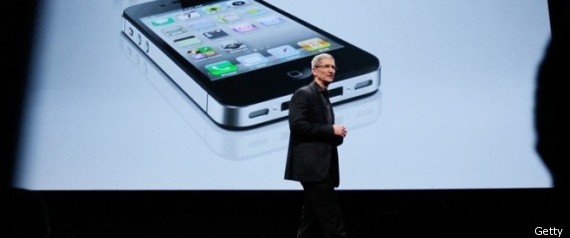
Apple Event Reportedly Scheduled For October: All Things

Tired of waiting for the next iPhone? Mark your calendars! The iPhone 5 could be announced at an Apple event on October 4, according to tech blog and Huff Post Tech partner All Things Digital.

AllThingsD reports that, according to "sources close to the situation," new CEO Tim Cook will give the keynote address at an event on October 4, which will be used to introduce the much-anticipated iPhone 5 to the world. The release, according to those same anonymous sources, will come weeks later, presumably before the end of the month. AllThingsD had previously reported that the iPhone 5 would definitely be released some time in October, though they had not given any specific time frames in previous reportage.

Previously, the most popular rumor (from tech site Boy Genius Report) had put the actual launch of the iPhone 5 in early October ,with well-connected Apple blogger Jim Dalrymple confirming, though this latest rumor has the release of the iPhone 5 pushed back once again. The also well-connected AllThingsD all but started the legitimate iPhone 5 release date bonanza with a rumor that the next-gen Apple smartphone would come out in September, though the site has since maintained October as the target launch month.

Apple, of course, has yet to confirm anything or send out invitations to any press event. The company generally held a September media event to announce updates to their iPod line, though this year it appears they will skip talking to the press in September altogether.

For weekly roundups of the latest gossip in the Apple world, check out HuffPost Tech's This Week in Apple Rumors series and, as always, keep checking back for the latest on the iPhone 5 release date.

WATCH:
Read more >>

Why you won't see smaller iPads next year - though you will see revised iPads

The splendid supply chain rumour mill Digitimes is reporting that "Component suppliers including touch panel and reinforced glass suppliers for Apple's iPad are completing validation with Apple for the second-generation 9.7-inch iPad, according to Taiwan-based component suppliers. Apple is expected to launch the second-generation iPad in the first-quarter of 2011, the suppliers noted."

This report is pretty unequivocal - it gives you the size of the screen and it gives you a timescale (the latter matching Apple's usual timescale for launching revisions of its computer-ish products, ie announce them in January (like it did with the iPad - remember? - and iPods).
Read more >>
Next Post